News Story
BIOE Ph.D. Student Secures Funding for Rare Lung Disease Research

A drug that helps the immune system fight a rare lung disease can also inflame the lungs it is meant to protect. Fischell Department of Bioengineering (BIOE) at the University of Maryland, Ph.D. candidate Ashleigh Jankowski is developing tiny, drug-carrying nanoparticles designed to deliver the treatment more precisely, with the goal of reducing inflammation and minimizing damage to healthy tissue, while still treating the disease. To advance her research, Jankowski secured $10,000 through ResearchHub, an open-science platform that supports research through community funding and encourages scientific discussion and peer review.
Jankowski's research focuses on lymphangioleiomyomatosis (LAM), a rare, progressive lung disease that primarily affects women of reproductive age. The disease causes abnormal cells to grow in the lungs and lymphatic system, forming cysts that gradually damage healthy lung tissue and make breathing difficult. The only FDA-approved drug treatment, rapamycin, can slow disease progression, but is not a cure--and it does not work for about 40% of patients. Others may initially respond but eventually stop benefiting from the drug or struggle to tolerate its side effects.
In the Maisel Lab led by BIOE Associate Professor, Katharina Maisel, Jankowski is exploring another approach by using the body's own immune system to fight the disease. Earlier studies showed that CpG, a synthetic DNA molecule that activates immune responses, increased survival and reduced cyst formation in mice with LAM. But administering the drug on its own also triggered significant inflammation in the lungs, potentially damaging the healthy tissue researchers are trying to protect.
Jankowski is addressing this problem through targeted drug delivery. She packages CpG into nanoparticles designed to carry the treatment to the lymph nodes that drain the lungs. These lymph nodes act as coordination centers for local immune responses, making them a promising target for activating the body's defenses against LAM. By directing more of the drug toward these areas, she hopes to limit inflammation in surrounding lung tissue.
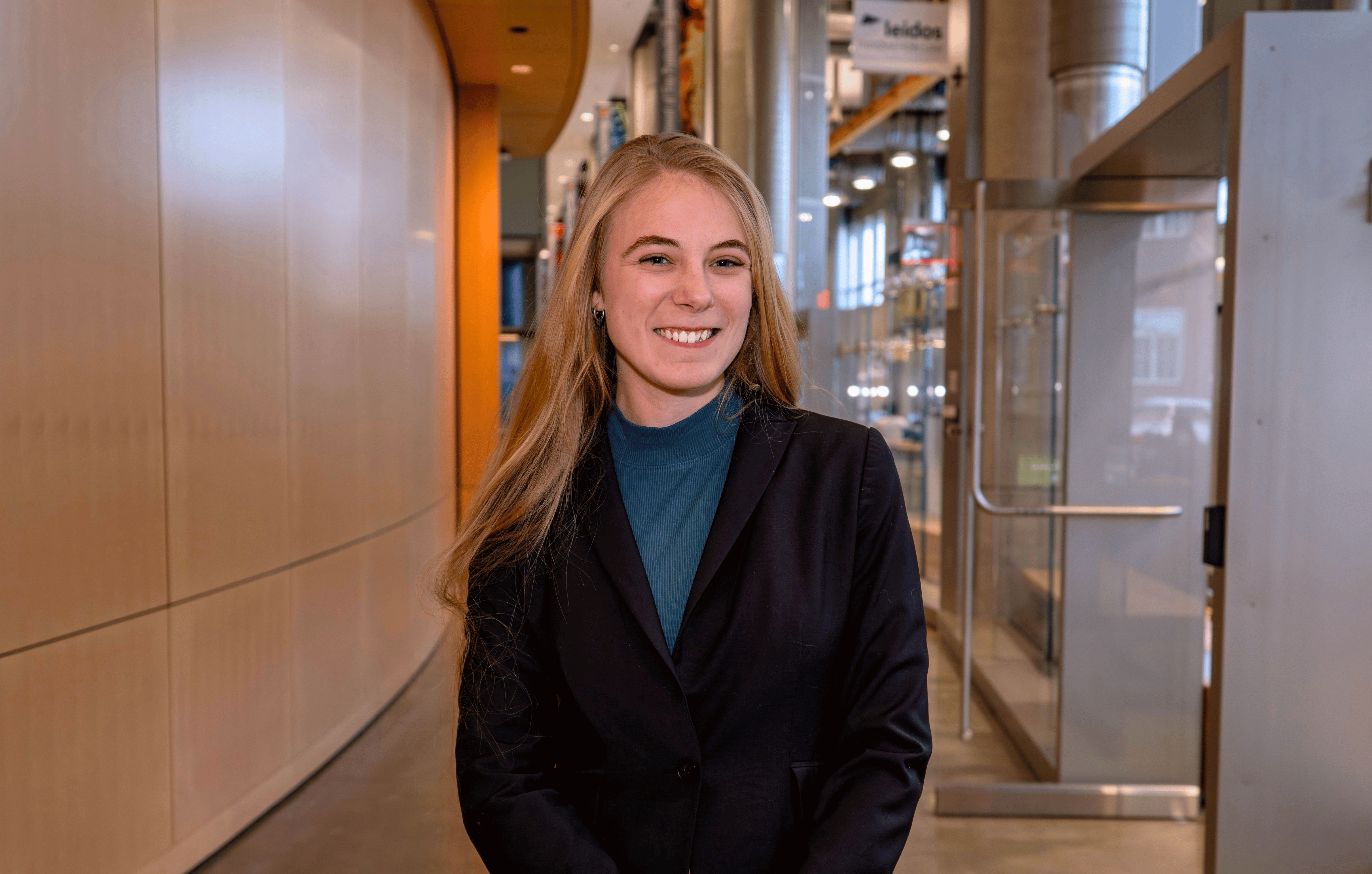
"I’ve always been interested in women’s health and immunology, and this project was really the intersection of those interests," she said.
Much of Jankowski’s work takes place in the BioWorkshop, a shared core facility in A. James Clark Hall led by BIOE Director, Christian Pick. There, she uses specialized instruments to measure the nanoparticles’ size, surface charge, and the amount of drug each carries. She then moves experiments to the university’s Department of Laboratory Animal Resources, which houses an imaging core where researchers can observe how the nanoparticles accumulate in the lungs and lymph nodes, and monitor disease progression in live mice.
"Even visually before running the numbers, you can just look and see those mice are healthier."
-Ashleigh Jankowski
In an initial pilot study, Jankowski and her collaborators found that mice treated with nanoparticle-delivered CpG appeared to have fewer lung tumors than mice receiving the drug on its own or with no treatment. Jankowski examined lung tissue after 60 days, finding evidence that packaging CpG into nanoparticles could improve its ability to reduce disease burden. Slices of lung tissue showed the contrast clearly, she said.
“Even visually before running the numbers, you can just look and see those mice are healthier,” she said.
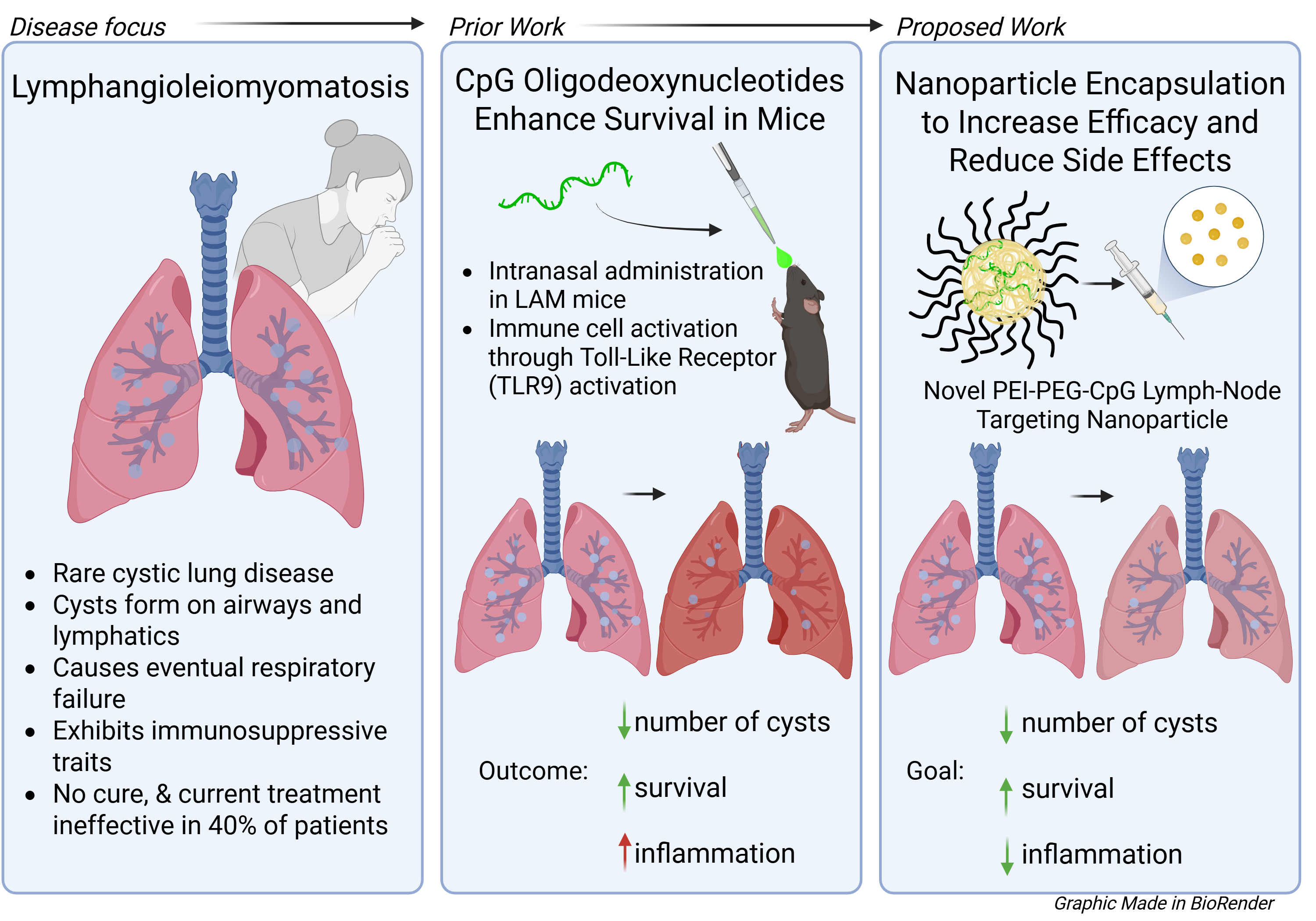
The next phase will test those findings in larger groups of mice. Jankowski and her team will compare the nanoparticle treatment with free CpG and a control treatment, evaluating survival, lung tumor burden, and inflammation. The funding covers about six months of work, with time reserved to repeat the study and adjust the particle formulation if needed. If the results hold up, researchers will need to conduct additional studies to provide further mechanistic insights into how the treatment works and further evaluate its safety. Those findings could help guide testing in larger animal models and eventually clinical trials.
Jankowski was also recently named a Fischell Fellow, at the annual BIOE EPIC Retreat. Named for department namesake and inventor Robert E. Fischell, the fellowship recognizes graduate students whose applied research and product design could transform human health.
The opportunity to continue the research came after Jankowski received an email about a ResearchHub funding call focused on immunology and immunotherapies. After sharing her desire to apply with Maisel, she submitted a three-page proposal outlining the project and its next research milestones. Four contributors from the ResearchHub community fully funded the request within two months.
“It’s essentially GoFundMe, but for science,” Jankowski said. The platform gives researchers another way to seek support beyond traditional grant programs, she said, and provides feedback on proposals even when they are not funded.
She hopes her experience encourages other graduate students and early-career researchers to look beyond traditional funding opportunities and take a chance on platforms they may not know.
Published November 13, 2026
Related Stories
Stories / November 9, 2026
BIOE M.D.-Ph.D. Student Receives PhRMA Foundation Fellowship to...

Stories / October 21, 2025
AI Tool Reveals Gaps in Ancestry Reporting Across Biomedical...
Stories / September 8, 2025
BIOE Announces 2025 Fischell Fellows at EPIC Retreat
Stories / June 24, 2025
UMCP, UMSOM Launch B.S.-M.D. Program to Bridge Engineering,...
Stories / February 3, 2025
Callie Weber Earns Third Place in Dean's Ph.D. Research Award...

Stories / May 3, 2024
Unveiling Nanoparticle Transport: Transforming Drug Delivery
Stories / March 14, 2024
Two BIOE Students Win Outstanding Graduate Assistant Awards
Stories / October 27, 2026
BIOE Senior Sulayman Khan Elected UMD SGA President

Stories / September 29, 2026
BIOE Celebrates Five Award Recipients at Ninth Annual 2026 EPIC...
Stories / September 21, 2026
Ribbon-cutting Celebrates Baltimore Center Where Engineers,...
