News Story
Mueller Lab Receives Two NIH Grants to Advance Low-Cost Cancer Care

The Fischell Department of Bioengineering (BIOE) Associate Professor and Robert E. Fischell Institute for Biomedical Devices Affiliate Fellow Jenna Mueller and her research team have received two new National Institutes of Health (NIH) R01 grants to develop low-cost technologies designed to expand access to cancer care in communities with limited medical resources. Awarded Aug. 21, the grants provide a combined $6.7 million to support two five-year projects through 2031.
One grant will advance the KeyScope, a low-cost laparoscope designed to make minimally invasive surgery more accessible in low-resource settings. The second, a joint project with BIOE Associate Professor Katharina Maisel’s lab, will develop a topical ethanol-based gel to treat low-grade cervical dysplasia, a precancerous condition affecting cells on the surface of the cervix.
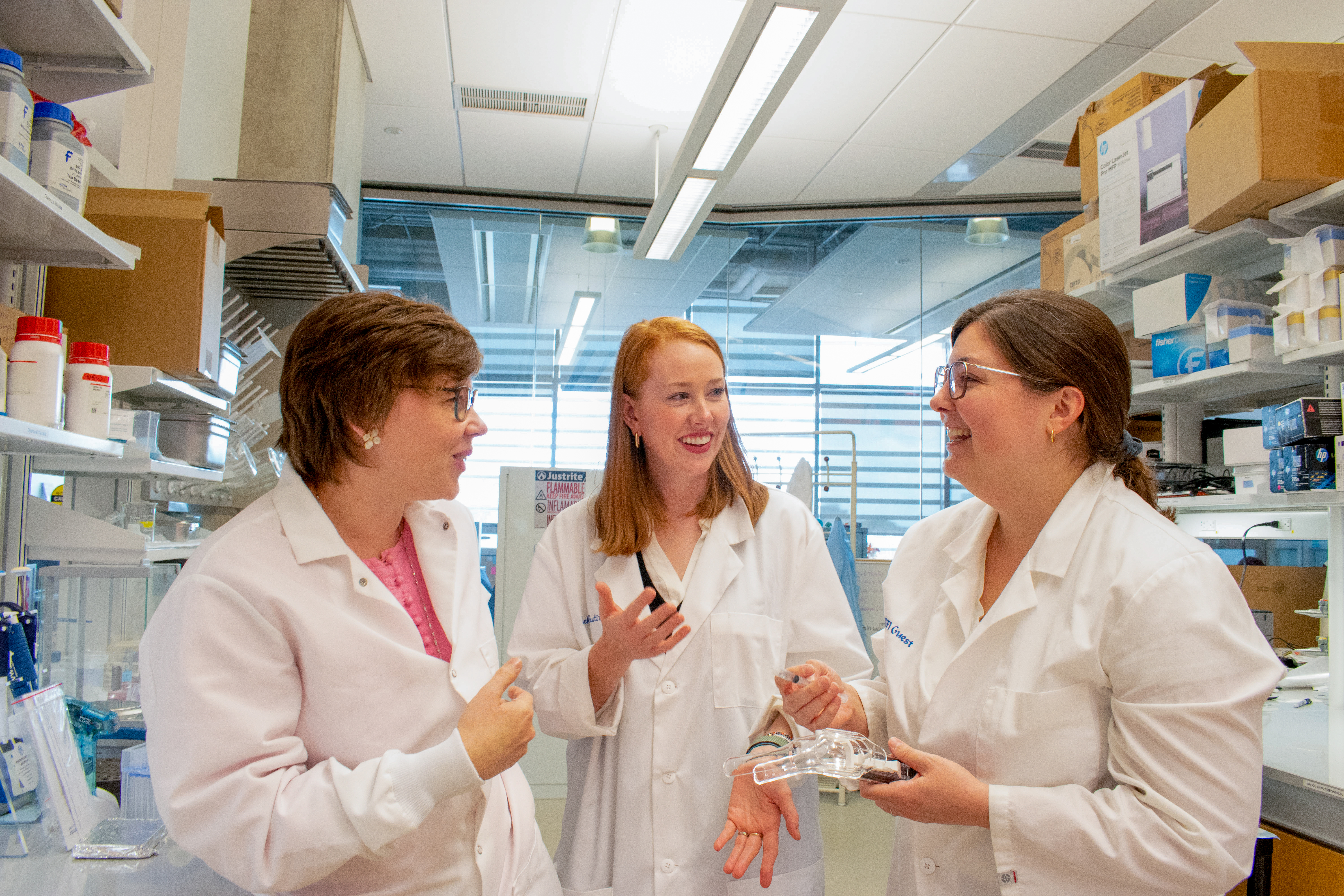
As principal investigator of the Global Biomedical Devices Lab, Mueller develops diagnostic and therapeutic technologies for cancer care in settings where conventional medical equipment may be too expensive, difficult to maintain or unavailable. Her work combines engineering design with clinical needs to create tools that can function in the environments where they are needed.
The first R01, “Multimodal KeyScope Laparoscope: Increasing Access to Laparoscopic Surgery,” provides $3.2 million to expand the KeyScope into a suite of laparoscopes that can support different surgical procedures. Laparoscopic surgery uses a small camera and instruments inserted through small openings instead of the large incision used in open surgery. The approach can reduce postoperative complications and recovery time, but conventional laparoscopic systems can cost more than $100,000 per operating room and rely on specialized equipment and maintenance that may not be available in rural or low-resource communities.
Mueller’s team is developing KeyScope with a target cost of around $2,000. Unlike conventional systems that rely on fragile fiber optic cables, KeyScope uses light-emitting diodes and a digital image sensor positioned at the tip of the device. The system is designed to be portable, durable, reusable, and compatible with simpler sterilization methods, while reducing its dependence on continuous electricity.
The team has developed a 0-degree scope KeyScope that provides a straight-ahead view. With the new funding, researchers will work with the Robert E. Fischell Institute for Biomedical Devices to develop a 30-degree scope, allowing surgeons to see different areas inside the abdomen. They will also add fluorescence imaging, a technique that can help surgeons visualize structures during an operation.
“I’m so excited we get to continue our work on these global health projects. This will enable more graduate students to work on projects that are focused on global health applications.”
-Jenna Mueller
The new KeyScope designs will be evaluated through laboratory testing, abdominal models and animal studies before human testing. Anne Barnes, a graduate student in Mueller’s lab, along with collaborator and Associate Professor of Surgery at Duke University, Tamara Fitzgerald and the Fischell Institute, are collaborators on the project.
The second R01, titled “Topical ethanol gel to precisely treat low-grade cervical dysplasia,” provides $3.4 million for a joint project led by Maisel. The researchers are developing a topical gel that can be applied directly to areas of low-grade cervical dysplasia to treat abnormal tissue while leaving healthy cervical tissue intact.
Low-grade cervical dysplasia may resolve on its own and is often monitored rather than immediately treated. That approach depends on patients returning for follow-up screenings to make sure the condition does not progress. In safety-net and low-resource communities, however, patients may face barriers to returning for care. Current treatments also can require equipment or supplies that are difficult to access in rural settings.
The new project builds on Mueller’s earlier work with ethyl cellulose-ethanol (EC-ethanol) ablation, which is designed to destroy precancerous cells while limiting the treatment’s spread to surrounding tissue. The new formulation uses a methyl cellulose-based ethanol gel that can form quickly and adhere to wet tissue. The team will develop the gel for localized release for up to 24 hours and design an applicator and cup device to keep the treatment concentrated at the cervix.
The project also builds on a collaboration that began informally several years ago. Mueller said the idea for the topical gel started with a conversation with Maisel over coffee and has now developed into a federally funded research project. Research Technician and Faculty Specialist Michele Kaluzienski in Mueller and Maisel Labs and Dr. Julie Hurvitz, Assistant Professor in Obstetrics, Gynecology and Reproductive Sciences at the University of Maryland School of Medicine, are also recognized as collaborators on the project team.
“I’m so excited we get to continue our work on these global health projects,” Mueller said. “This will enable more students to work on projects that are focused on global health applications.”
The new funding also moves Mueller’s technologies closer to clinical use. The KeyScope is scheduled for a clinical trial in Uganda in 2027, while the EC-ethanol ablation therapy is scheduled for a clinical trial at the University of Maryland School of Medicine in 2028.
Published October 5, 2026
Related Stories
Stories / September 16, 2026
New Faculty Members for 2026-27 Engineer for the Public Good
Stories / September 14, 2026
Project, Problem, Solution: MATRIX Interns Make an Impact
Stories / September 10, 2026
BIOE Announces Faculty Promotions and Appointments

Stories / September 3, 2026
UMD Convocation will honor five from the Clark School
Stories / August 18, 2026
New Faculty Spotlight: Yu Gan
Stories / August 4, 2026
Kuo Lab Hosts Future Bioengineers
Stories / June 25, 2026
Grand Challenges 2.0: Engineers Partner to Unlock Solutions

Stories / June 15, 2026
Alisa Morss Clyne Named Interim Chair of UMD Bioengineering
Stories / May 29, 2026
BIOE Announces Spring 2026 Instructional Impact Awards
Stories / May 26, 2026
Apply: Chair of the Fischell Dept of Bioengineering
