News Story
A “Key” Step Toward Safer Surgeries Worldwide

Surgical complications worldwide claim more lives each year than tuberculosis, HIV and malaria combined. While minimally invasive laparoscopic methods, which involve inserting a thin instrument with a camera through a small incision, could likely prevent many of those deaths, patients in low- and middle-income countries rarely have access. Just one operating room outfitted with even the most modest system costs $130,000 or more.
Now, a team of University of Maryland engineers is partnering to stitch up those gaps in affordability.
KeyScope, the group’s durable, reusable device, reduces cost and complexity by replacing the standard system’s fiber optic technology with a tiny consumer-grade camera and ring of LED lights, complete with waterproof casing for easy cleaning. Backed by funding from the National Institutes of Health, UM Ventures and Wellcome Leap, the device, which can be built for around $1,000, has already been successfully tested in pigs and is slated in summer 2026 for human clinical trials at the Uganda Cancer Institute in March.
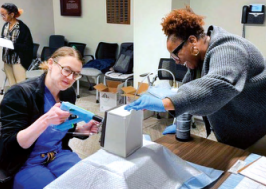
“You don’t want to have to make a large incision, so it’s a huge engineering challenge to develop a scope that fits within a standard 5-millimeter-diameter trocar port,” says bioengineering Assistant Professor Jenna Mueller (above), who’s partnering with the Robert E. Fischell Institute for Biomedical Devices to further develop the device. “But we’ve been able to figure out how to do it and get the same level of image quality as that really expensive standard-of-care system.”
Mueller was no stranger to such medical engineering feats, having previously applied her skills to devices that expand access to lifesaving care. During her postdoctoral research at Duke University, she helped work on the Pocket Colposcope, a low-cost, portable instrument to screen women for cervical precancer that’s now on the market.
That caught the attention of Tamara Fitzgerald, associate professor of surgery and associate research professor of global health at Duke, who’d been working in Uganda. She’d been forced to perform fully open procedures there, with laparoscopes unavailable in the country. Could they apply the technology from the colposcope to a low-cost device for hysterectomies, appendectomies and other abdominal surgeries?
“Most people in the world don’t have access to laparoscopic surgery,” Fitzgerald says. A device like KeyScope could improve recovery times and reduce infection rates not only in Uganda, but also in surrounding nations in Africa and other low- and middle-income countries in Asia and South America. “It could be a pretty big impact.”
After they created the initial prototype, Mueller brought it to UMD when hired in 2020, where she teamed up with the Fischell Institute’s chief engineer, John Rzasa, and senior engineer, Kevin Aroom, to refine it and address design challenges. One, for example, was the ring of LED lights. The 5-millimeter circle needed to provide enough illumination for a surgeon to see the whole abdominal cavity, without generating too much heat and damaging the attached camera. The solution: Pulse the lights in sync with the camera’s frame rate.
“The LEDs are actually off most of the time,” says Rzasa, an expert in designing custom camera systems. “But to the user, it appears like they’re on all the time.”
Another major issue for the low- and middle-income countries that would use KeyScope is sterilization. In these nations, hospitals often don’t have the gas hookups or autoclaves typically used for high-pressure steam cleaning of reusable medical equipment. So Aroom created a custom, hermetically sealed casing to allow for repeated submersion in a readily available disinfectant called Cidex.
Even with all the modifications, the team is working to keep the device accessible and easy to make—“don’t design stuff that you need a Ph.D. to assemble,” Rzasa says. In collaboration with Ugandan medical equipment manufacturer Shishi International, they’re guiding local engineers to put together the devices in makerspaces, testing limitations and tracking build time. For example, Mueller says, if the available soldering equipment was difficult to work with, she and the team could try to eliminate some of the soldering steps. So far, the process has helped cut the manufacturing time in half.
That back-and-forth to create a sustainable model has been the most rewarding aspect of the project, Mueller says.
“My favorite part is when the Ugandan engineers make a scope and it works. They plug it in, the light turns on and they’re so thrilled,” she says. “I even see that with students here at UMD. If you make something that works, it’s such a confidence boost. It’s a powerful feeling.”—AK
Team Develops Another Low-Cost, Lifesaving Solution
After creating an inexpensive cervical precancer treatment for low- and middle-income countries, a UMD team led by Mueller is exploring the best way to deliver the lifesaving care.
The researchers tested three ways to inject the mixture of ethyl cellulose and ethanol (EC-ethanol), which forms a gel upon contact with tissue and dramatically reduces leakage and off-target damage. One option was a single-needle injector, another was a multi-needle injector, which delivered the treatment to three locations in the cervix simultaneously, and the third was an “extender injector,” which used a shorter needle attached to a longer extender shaft.
The study published in Springer Nature found that the extender injector offered the best combination of precision, ease of use and affordability. Each dose of EC-ethanol is expected to cost less than $1, and the injector design can be produced for under $10.
Now, a $3 million Method to Extend Research in Time Award from the National Cancer Institute will support a clinical trial at the University of Maryland School of Medicine.
The World Health Organization reports that cervical cancer is the fourth most common cancer in women globally, with around 660,000 new cases. It killed about 350,000 in 2022.
“We believe we can significantly reduce this number in our lifetime if diagnosis and treatment technologies are made accessible to all,” says Mueller.—LT
Published June 2, 2026
Recent Stories
Stories / Oct 6, 2026
FDA Awards Sochol-Led Team $873K to Build Retina Models

Stories / Oct 5, 2026
Mueller Lab Receives Two NIH Grants to Advance Low-Cost Cancer...

Stories / Sep 29, 2026
BIOE Celebrates Five Award Recipients at Ninth Annual 2026 EPIC...

Stories / Sep 25, 2026
UMD Bioengineering Undergraduate Program Continues Strong...

Stories / Sep 22, 2026
Two Years Running, Maryland #12 Among Publics for Undergrad...

Stories / Sep 21, 2026
Ribbon-cutting Celebrates Baltimore Center Where Engineers,...

Stories / Sep 16, 2026
New Faculty Members for 2026-27 Engineer for the Public Good

Stories / Sep 14, 2026
Project, Problem, Solution: MATRIX Interns Make an Impact

Stories / Sep 10, 2026
BIOE Announces Faculty Promotions and Appointments

Stories / Sep 3, 2026
UMD Convocation will honor five from the Clark School
